Brand Consistency and 3 Small Things Your Organization Can Do to Establish (or Improve) Yours Before Close of Business Today

When I say the words “car insurance,” what is the first thing that pops into your head?

If you’re like me, it was a little green lizard with a Cockney accent telling you that 15 minutes could save you 15 percent or more.

But it could have been Jake from State Farm at 3 in the morning or a deep voice asking “Are you in good hands?”

Odds are your brain didn’t go straight to concepts like paperwork, policies, or coverage. It probably first went to a brand.

To become synonymous with the product or service that a brand provides, that brand has to do a lot of work. It has to be a strong. A strong brand stands for something and repeatedly and consistently delivers that message to its consumers across all mediums. Consistently, here, being the key word.

In the world of marketing and brand management, it is often said that the difference between good branding and great branding is consistency. If an audience gets different messages every time they interact with your brand, their perception will likely be negative.

Beth Pop-Nikolov explains this idea well in her recent article on Venveo.com saying:

“When you're getting to know a person, you start to develop opinions, ideas and assumptions about them based on your interactions. If they are dressed in a business suit one day, bermuda shorts and a ratty T-shirt the next and then a scuba diving suit another time, it may be hard to nail down exactly who they are and what they are all about.

Now imagine this same person is someone you are considering doing business with. Wouldn't you be concerned about their consistency in their work based on their inconsistent appearance? You may think twice before bringing them into your business because they're unpredictable.

Your consumers can feel the same about your brand if you aren't careful. If your social media voice is whimsical and silly but your product packaging is sterile and plain, you're sending mixed signals that will confuse consumers and leave them feeling like your brand can't be trusted.”

Your organization needs a reliable and consistent voice, and everyone (and I mean everyone from the CEO down to the associates, not just your marketing and communications team) needs to be speaking the same language. The more uniform, consistent, and steady your messaging and flow of content, the stronger your brand will be. And whether your goal is selling a product or raising money for a cause, you need a solid brand to do it.

By now, you should be convinced to revisit your organization’s brand for consistency. But where do you start?

Here are my top three things your organization can do today to establish (or improve) your brand consistency.

Conduct a Brand Audit

You can’t effectively plan a path forward until you know where exactly you’re at now, right?

You need to understand where your brand stands in its current state which is why you need to begin with a brand audit.

It’s completely normal (and desired) that your brand shifts and evolves over time. So it’s in your organization’s best interest to occasionally be conducting broad scans of your brand and where it is positioned in the market.

The team at Miles Herndon did a great job compiling an outline of all of the elements to consider when performing a comprehensive brand audit. Here’s what they came up with:

Internal Branding

  • Positioning

  • Brand Values

  • Unique Selling Proposition (USP), brand promise, or brand essence

  • Voice

  • Culture

  • Product / Service positioning

External Branding

  • Corporate Identity - logos and other brand elements

  • Collateral-brochures, print materials, trade show displays, etc.

  • Advertising

  • Website

  • SEO

  • Social Media

  • Sponsorships/civic-involvement/memberships

  • News/PR

  • Content Marketing and other assets - blogs, white papers, case studies, articles, books, etc.

  • Testimonials

  • Videos

Systems and Infrastructure

  • Corporate identity/brand standards

  • HR policies/on-boarding process

  • Sales processes/touchpoints

  • Internal systems

  • Customer service systems

Solidify and Articulate a Brand Style Guide (+ Cheat Sheet)

Once you’ve done all of the researching and gathering of all of your organization’s different assets you need to analyze it and codify it. That is: write it down in one place!

I don’t know how many times I’ve talked to organizations that didn’t have a one-stop-shop for questions and rules related to their brand. For a marketing and communications team, this resource becomes their Bible. For the rest of the organization, it becomes an invaluable resource to answer questions they may have without having to ask the marketing and communications team about simple things like logo use, proper capitalization of a phrase, or specific brand color codes.

Here’s an example of a digital Style Guide that ensures that brand assets are at the fingertips of each employee.
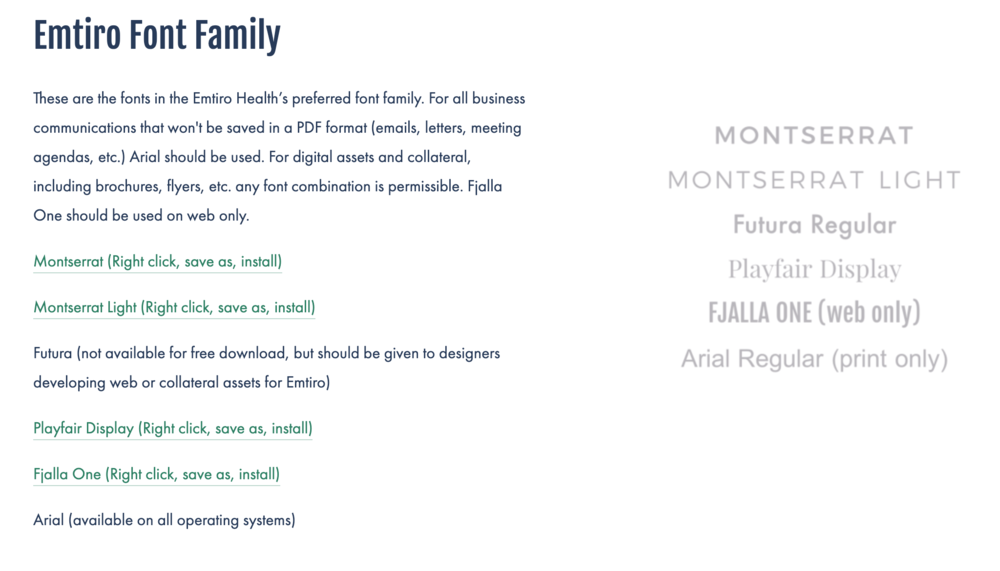
Credit: Atrómitos

Credit: Atrómitos

Whether your brand style guide is online or you print out hard copies for every employee similar to an employee handbook (we’d recommend this!), there are common elements that you’ll need to make sure you define and have all in one spot. We’ve detailed those below and included thinks to consider within each element. These include:

Color palette

  • Define your organization’s color palette, including each color’s specific RGB, CMYK, and HEX codes.

  • Define which colors primary and secondary colors (Ex: Certain colors that you want to use more than others).

Typography

  • Define your brand-approved fonts, which fonts are used for headers, subheaders, and body text, and what size font is appropriate for each.

  • Define if any fonts are for use only online or only in print (If those fonts are not automatically included on everyone’s computer, include links to where they can be downloaded for free).

Logos

  • Include all approved versions of your logo (Ex: dark, light/white, horizontal, vertical).

  • Include proper and improper usages of your logo (The amount of space that should always surround it, not to stretch or distort the logo, not to put it on a busy background where it is hard to read, etc.).

Icons and word-marks

  • Include any icons or wordmarks that can stand in for your logo as well as proper use of each.

Mission Statement/Brand Philosophy/Brand Idea

  • Define your brand succinctly. What words define your brand presence? What ideas drive your work? Write it all down.

Editorial Style Guide

  • Define your organization’s editorial style (whether that adheres to a mainstream Stylebook like Associated Press or Chicago, or pulls from pieces of each).

  • Define things like the use of the Oxford comma, extra spaces after sentences, etc.

This list is by no means extensive and is certainly dependent upon your particular organization’s brand and identity, but it’s a good place to start.

When you’re finished with the all-encompassing style guide, we’d recommend creating a truncated, one-page version of the most important, most-used aspects (think: fonts, color codes, etc.) that your staff members can print and hang at their desks for quick reference. And finally, if you’d like to see what some other brand’s style guides look like, you can check out this Hubspot blog article.

Start With the Small Stuff!

You’ve audited your brand and you’ve codified everything into a brand style guide. Congratulations! That’s a lot of hard work. Now it’s time to implement. But you might find yourself staring at your wealth of different marketing materials, pamphlets, flyers, banners, and website and feeling overwhelmed. We totally get it.

Start small.

The logistical part of refreshing your brand will take time and will likely require a transition period. It can help to even create a concrete plan for that period and dates for when you will aim to have certain deliverables transferred over by. But in the meantime, here are three small brand items you can do that’ll give your new, improved brand a wide presence:

1.    UNIFORM E-MAIL SIGNATURES

It might seem like a minuscule detail but with so much professional communication occurring online, a clean, professional e-mail signature across your organization is a must. So get it out of the way early so everyone external to your organization that gets an email gets a glimpse of your brand.

In terms of the actual implementation of the signature across the organization, I’m a big fan of Email Signature Rescue, a paid online resource that offers professional, responsive signature templates and then helps you deploy that signature to everyone in your organization with the click of a button. Much easier than lengthy, complicated instructions telling people the exact menu items to click to get their new signature up and running. 

2.    NEW BUSINESS CARDS

Much like your new e-signature, a new branded business card is a small tool that can make a big impression while getting your updated brand out there. Make sure that they’re clean, modern, and contain all important information including contact information and social media handles. Take advantage of double-sided printing, making one side all of the information and the other side colorfully branded. Another rec: Check out Moo.com for your business card needs. Moo also has a wealth of tried and true templates to work from (work smarter, not harder people!) and extras like foil, rounded corners, or unique business card sizes that can bring your cards to life!  

3.    LETTERHEAD AND POWERPOINT TEMPLATES

Get your professional business letterhead together first thing so that any letters (proposals, acknowledgments, etc.) that start going out can bear the new look. Creating a full toolkit of branded templates including a powerpoint template that staff members can easily edit to create their own presentations is key to brand consistency! It’s when people across the organization are creating their own letterhead and things on the fly that brand inconsistencies spring up.

If you’ve read this far and you’re still thinking, “This might be a little out of my wheelhouse,” or “I have more specific questions and I could use some help thinking through how this applies to my organization’s brand,” feel free to reach out to me directly.


This article was originally written by me for Atromitos’ Ideas blog and has been slighted edited for publishing here.

Project Spotlight: Doodle Portrait Collage

This will probably come as pretty much NO surprise, but let me just say: I’m kind of the queen of handmade/homemade gifts.

Gift giving is 100% my love language when it comes to showing affection for those whom I care about.

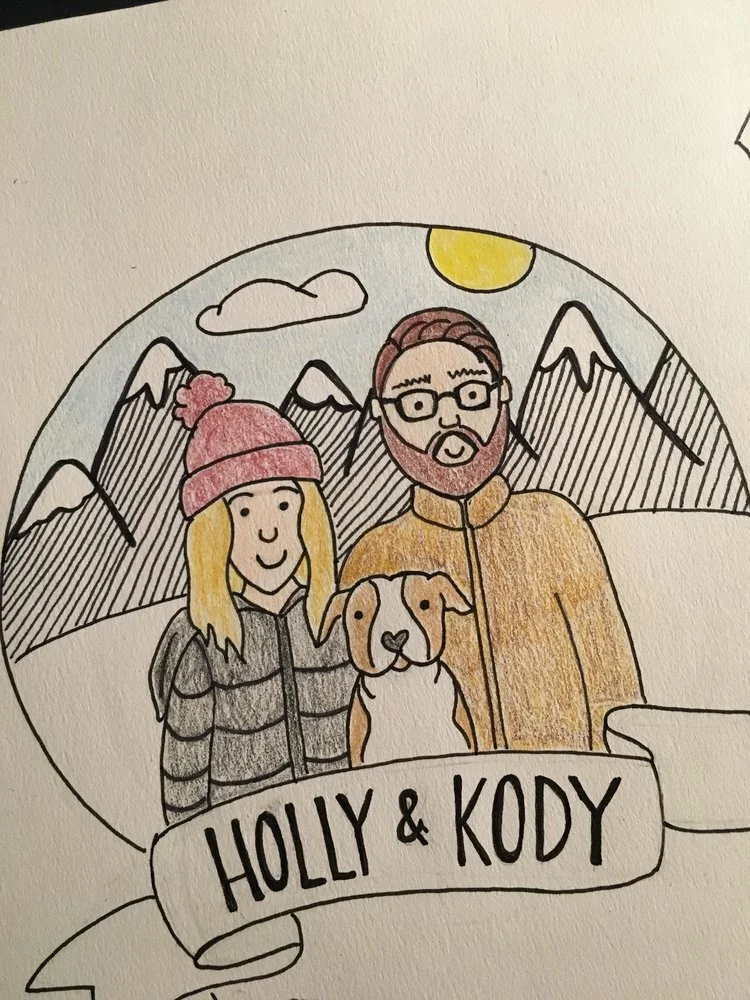
That said, when my boyfriend and I’s one year anniversary of dating was approaching, I was so excited and started thinking about a special gift at least a month in advance. (I’m pretty extra - I understand.) I wanted to make something that was special and represented our year of adventures together. And thus, the “doodle portrait collage” was born.

The “doodle portrait collage” as I’ve come to describe this fun piece is a combination of doodle drawings in pen and colored in with colored pencils on regular drawing paper.

The “doodle portrait collage” as I’ve come to describe this fun piece is a combination of doodle drawings in pen and colored in with colored pencils on regular drawing paper.

My process for creating this piece first began by me creating a list on my phone of everything I thought I wanted to try to include in the piece (it was a pretty long list)! I had worked on compiling the list for a couple of weeks before I put anything to paper because I wanted it to be as fleshed out as possible so I didn’t realize at the last minute that I forgot something big and then not have accounted for space to include it.

When making my list of things to include, I was thinking of:

  • Places we have traveled together (Chicago, Raleigh, New York, and our home states of Pennsylvania and Indiana)

  • Things we individually love (although, I’ll argue there’s a lot of overlap with things that we individually love and things we both love) including breakfast sandwiches, champagne, basketball, pizza, sunflowers, weiner dogs, Beyonce, LeBron James.

  • Things we love to do together: go to concerts, cook, ride electric scooters, etc.

  • Funny memories and inside jokes. One that I included on ours is a snake that says “SSSSSTEPHEN” next to it. It’s a memory of when I picked up a rubber snake at a thrift store when my boyfriend and I were driving from Pennsylvania to Indiana over the Holidays and used it to prank him. We then had this rubber snake with us for the remainder of the trip and decided to give him the name “Stephen” (but you had to pronounce it like SSSStephen in a snakelike manner). We almost lost him when we stuck him in a friend’s hotel bed on New Year’s Eve and we thought they left him at the hotel…but he made his way back to us at the next get together. In case any of you were ultra curious about the snake. ;)

My rule, generally, was that if there was a way to easily visually depict an item on the list, I’d go for the doodle over just writing words. But obviously with concepts like “Communication,” and general things like “friends,” it was easier to just write out the words for those. I wanted most of the doodles to be obvious what they were, so if I didn’t think I could do the doodle justice, I would just write out the word.

I started by doing a pencil sketch of our cartoon portrait in the center, including both of our pets, Jack the cat, and Noodle the dog. And then just got to work checking things off my list as I included them.

One thing I did learn, towards the end, was that I couldn’t run my doodles up to edge as tight as I did because it became somewhat difficult to find a frame that didn’t cut pieces of the doodles off. I believe the frame I ended up going with was more of a “document holder” than a frame, so it didn’t cut anything off. It wasn’t necessarily what I had envisioned for framing it, but it was the only one that didn’t cut things off.

After delivering this one to my boyfriend and sharing it on Instagram, a dear friend of mine out in Colorado actually commissioned me to create one for her and her boyfriend as well.

Here are some pictures of their collage (and its evolution):

Long story short, I really loved creating these projects and how creative and personal they are for the person giving and receiving it! If you could use a handmade, thoughtful gift for a loved one, shoot me an e-mail and let’s chat!

Brea (1).png

In a world where you can be anything...

…be kind.

Simple enough, right?

I just finished reading a book called Lincoln in the Bardo by George Saunders. I wouldn't say it was my favorite book (I gave it 3 stars on Good Reads) but there were definitely some great messages throughout, including this one about Abraham Lincoln's mental state after losing his son Willie to typhoid:  

“[Lincoln's] mind was freshly inclined toward sorrow; toward the fact that the world was full of sorrow; that everyone labored under some burden of sorrow;... that whatever way one took in this world, one must try to remember that all were suffering, and therefore one must do what one could to lighten the load of those with whom one came into contact.”

At first glance, the quote reads pretty dismal..."the world is full of sorrow," etc. But there are a couple underlying messages here that, as I was reflecting, I realized I wanted to share.

The first, and perhaps most obvious message is that of doing your best to treat each and every person you encounter in your day-to-day life with kindness. When I was working on the sign above with the jar of felt flowers, I wasn’t sure exactly what phrase to paint over top of the jar. I was working on this project around the same time that I was reading Lincoln in the Bardo and came across the aforementioned passage. That’s when I knew the simple phrase “Be kind” was what I would go with.

Listen… before I go any further, I will not even pretend to act like practicing kindness always is the easiest habit in the world. Personally, patience is not a virtue in which I would consider myself abundantly endowed (See: My frustration with slow sidewalk walkers, waiting for food delivery when I’m hangry, etc.). I get that certain people/personalities can just really grind your gears. You too are entitled to your share of bad days when you just don’t feel like putting your best foot forward. Seriously, I get it.

But today I’m offering up a challenge to everyone, myself included. And the challenge comes in the form of a quote from the Dalai Lama:

download (3).jpg

“Be kind whenever possible. It is always possible.”

It’s always possible. It’s always your choice to make. Even with that person who cuts you off in the grocery store parking lot or the one who calls you at work and dishes you attitude right off the bat. The truth of the matter is, that person might be struggling to cope with a mental illness. They might have a loved one who was recently given a rough diagnosis that has rocked their world. They might have accidentally lost an irreplaceable family heirloom while walking down the street. They might have just lost their job and are doing everything they can to make ends meet. Or they might have simply had a “Comedy of Errors”/”Murphy’s Law” sort of day.

These people take their frustration out on you and, while that’s not right or fair to you, matching their anger or frustration with kindness might just give them a wake up call from their slump. You might be the reminder that goodness is out there, even in the midst of the hot pile of garbage they may have been dealt recently. Your kindness may be the only ray of sunshine they have that day, and it may be the sole thing keeping someone from throwing in the towel. You truly never know.

The other thing this quote has me thinking about was the concept of suffering as a uniting human condition.

Again, it feels a little weird for me to focus on something negative like suffering as something that has the power to unify everyone. I mean everyone.

The quote from Lincoln in the Bardo that I mentioned above actually continues past the part I quoted and says, “…His current state of sorrow was not uniquely his, not at all, but, rather, its like had been felt, would be felt, by scores of others, in all times, in every time.”

In our current time, a time wrought with such division and divisiveness, it is sometimes easy to feel like you have nothing in common with certain people. Their views on politics, religion, child rearing, or how they take their coffee may be totally different than you, but the fact of the matter is that every single person experiences loss and sorrow in their lifetime. It’s an unfortunate, but unavoidable part of the human condition. If nothing else, we are able to connect and empathize with this part of each other.

And speaking of empathy, I have found this particular trait to be a powerful tool in spreading kindness. Those who have experienced suffering face the choice of how they will let that experience shape them. Understandably, suffering can harden many people. And that may not be their choice, but more a necessary coping mechanism depending on a person’s unique situation or environment. But if you allow it, I believe that suffering can open your heart to deeper compassion for others in the form of empathy.

I have experienced this through my personal struggles with anxiety and depression. I feel like knowing what it’s like to be in the grips of anxiety or in the lowest lows of depression has given me a sensitivity to other’s similar struggles as well as a unique platform from which to extend a hand in kindness to that person. “You don’t know how I feel” or “You can’t possibly understand what I’m going through” are ideas that close people off. But when you know what that person is going through because you have been there yourself, you are uniquely positioned to have a great impact on that person through kindness.

So the message here is simple: It's so important to be kind. Not just nice, but kind. And I think today's a good a day as any to start small with a random act of kindness, what do you think?

To help you out, here’s a few ideas of some small, kind actions that can make a big difference today:

  • Text a friend you haven’t talked to in a while and let them know you were thinking about them

  • Pay for the person’s coffee in line behind you at Starbucks

  • Compliment your significant other, a friend, or even a stranger - throw compliments around like confetti!

  • Exercise (self-kindness counts too!)

  • Leave a small business a raving online review

  • Write encouraging notes, go to a bookstore and stick them in random books for an unsuspecting purchaser

  • Buy a person experiencing homelessness a meal

  • Drop a dollar in the next tip jar you see

  • Sign up to volunteer at an animal shelter

    With love & kindness,

Brea (1).png

A Complete List of Everything I Read in 2018

Last year, I decided to set my very first (adult) reading challenge to myself: 18 books for 2018. I set the goal through Goodreads and I needed to read a book and a half a month to reach my goal. I honestly had no idea if this was an overambitious or totally achievable goal or not since I hadn’t been really keeping tracks of how many books I was reading annually until then.

Untitled design (5).png

I read many popular books, as well as several that had been in my “To Read” stack for God knows how long. Without further ado, here’s a complete list of the 19 books I read in 2018:

  1. White Teeth by Zadie Smith

  2. Make Trouble: Standing Up, Speaking Out, and Finding the Courage to Lead by Cecile Richards

  3. The Glass Castle by Jeannette Walls

  4. Moonglow by Michael Chabon

  5. Little Fires Everywhere by Celeste Ng

  6. What is the What by Dave Eggers

  7. All the Light We Cannot See by Anthony Doerr

  8. The Bell Jar by Sylvia Plath

  9. The Underground Railroad by Colson Whitehead

  10. Hillbilly Elegy: A Memoir of a Family and Culture in Crisis by J.D. Vance

  11. The Great Gatsby by F. Scott Fitzgerald

  12. The Hitchhiker’s Guide to the Galaxy by Douglas Adams

  13. Becoming by Michelle Obama

  14. The Brief and Wondrous Life of Oscar Wao by Junot Díaz

  15. Pachinko by Min Jin Lee

  16. The Goldfinch by Donna Tartt

  17. Is Everyone Hanging Out Without Me? (And Other Concerns) by Mindy Kaling

  18. The Paris Wife by Paula McLain

  19. Where’d You Go, Bernadette by Maria Semple

So many great books!

This list includes two that have made it into my all time favorites list: All the Light We Cannot See and The Glass Castle. Side note: I’ve since seen The Glass Castle’s film adaptation starring Brie Larson and Woody Harrelson and I LOVED it, probably as much as I loved the book and that’s pretty rare to find. I would highly recommend both (book first, of course)!

I’ve also heard rumors that All The Light We Cannot See is being turned into a Netflix limited series. Fingers crossed they do it justice!

Pachinko , The Paris Wife, and Becoming also all earned high marks from me that year. I was so excited to reach and exceed the goal I had set for myself. I came up with the idea that each year moving forward, I would add one book, starting with 19 books for 2019.

I plan to do a recap of all of my 2019 reads just like this, so stay tuned!

Happy Reading,

How To: Create an Inspiring Vision Board for 2019

Vision boards are the. best.

Honestly, what’s more fun than sitting down with a stack of old magazines (and for me, a cup of tea), sifting through and clipping anything to resonates with you, inspires you, or makes you smile, and then pasting them all together to create something beautiful? Creating a vision board is my idea of a great night (or rainy afternoon, or Sunday morning).

Vision boards can be created at any time and can be specific to a facet of your life (you could create a vision board that is career focused only, based around how you hope to grow professionally) or it can be general and overarching like the one I created below. As one year ends and another is about to begin, we’re presented with a great opportunity to both reflect and then look ahead and visually outline our hopes, goals, and dreams for the next trip around the sun.

Below, I’ve outlined some items you need, or could use, to craft your vision board and I’ll also walk you through my creative & thought processes while making mine for 2018 below.

My 2018 vision board.

My 2018 vision board.

Here’s a (non-extensive) list of things you need/can use to create your vision board:

  • A surface (I like to use cardboard, old boxes work great. But you could use a corkboard or a regular piece of paper if you want.)

  • Old Magazines (Note that the types of magazines you have will guide the images and phrases you will be able to find in them. So you should search out magazines with the types of things in them that you think you will want on your board.)

  • Scissors

  • Glue sticks

  • An open heart for reflection and imagination :)

Optional:

  • Printed personal photos of family & friends

  • Stickers, glitter, markers, washi tape

  • Liquid inspiration: Coffee, tea, wine


To start, create a comfy, soothing place to create your board. Find a space that you feel comfortable in and that is large enough to spread out all of your supplies. A large table or the floor are great choices. Remember, the process of creating your board should be reflective and therapeutic. Add some music in the background, burn some candles or incense, or anything else that supports you in feeling comfortable and tapped into your desires.

As you begin, here are some questions you should think on to guide your creating. Write down some of your thoughts and refer back to them as you go:

As you move into the next year…

  • What do you want? What are you saving up for? What are your dreams and goals?

  • What do you need? What can you absolutely not live without?

  • What do you value? What do you aspire to? What guides your actions?

And as you’re flipping through, you might feel a little overwhelmed (magazines can do that) and unsure what to cut out. So here are some ideas of things to clip and how they related to my vision board above for reference.

  • Pictures of things you love or things that make you smile. For me that was golden retrievers, kitties, flowers, and champagne. Because these are things you love, they are obviously things you’ll want to carry into the new year. Besides, looking at your board should be uplifting and lots of these pictures help!

  • Pictures of activities that you want to do more of in the new year. For me that was pictures of yoga, travelling, and a group of friends at dinner together. Maybe you want to cook at home more, so you could include pictures of tasty foods. Or maybe you want to take up photography. You get the drill.

  • Cut out words or phrases that you want to manifest in the new year. For me those words were love, joy, cozy, minimalist, happier, and healthier. And the phrases were, “Create your own sunshine,” “Stop & Smell the flowers,” “Speak your truth,” “Make peace with yourself,” and “Your mental health is important.”

Here are some other things to keep in mind while crafting your vision board:

  • There are no rules for what you can or cannot put on your vision board.

  • However, your board should focus on the positive. Add things to your board that you DO want to accomplish or manifest. Try not to add anything to your board that you don’t want to do, even if the end result is positive. For example, if you want to quit smoking, I wouldn’t put a pack of cigarettes crossed out on your board, I would put the words “Create healthier habits” or something of the like that is focused on the positive action. This is something you want to be able to look at every day and be continually reminded of your goals. It should be positive reinforcement. However, I will say, in this example, if seeing a box of cigarettes crossed out is what motivates YOU, then do it. There’s no right or wrong here.

  • If you don’t find exactly what you are looking for in magazines, get creative. You can print things from the web, draw, or even just write things on colorful paper.

UPDATE: My new 2019 vision board!

UPDATE: My new 2019 vision board!

I’ve finished my vision board. Now what?

When you’re finished, place your vision board somewhere prominent so that you will see it every day of the new year. Creating your vision board is part one of the vision board process, but equally as is important is part two which involves reflecting on your board over the coming year and especially at the end when you can see how far you’ve come.

The next thing you can do is take your vision board and create your “Take Action” list. After all, “Vision is merely a dream without action.” If there are things on your vision board that you want to bring into existence, create actionable items that you can work on to make it happen. Exercise 3 times a week. Mark in your calendar when to call a friend. Buy some succulents. Whatever it is, you are in control of how far you will go this coming year.

Reflect. Dream. Visualize. Take Action.

You got this!

Brea (1).png